Introduction
The concept of galactic expansion and colonization has long captivated the imagination of scientists, futurists, and the general public alike. As humanity stands on the brink of significant advancements in space exploration, the potential for establishing human presence beyond Earth has transitioned from the realm of science fiction to a plausible future endeavor. This article explores the technical specifications, potential applications, challenges, and future prospects of galactic expansion and colonization, situating these discussions within the broader context of space exploration and cosmology.
Theoretical Foundations of Galactic Expansion
Definition and Scope
Galactic expansion refers to the theoretical process of humanity spreading across the Milky Way galaxy, establishing colonies on various celestial bodies, including planets, moons, and asteroids. This concept encompasses not only the physical relocation of human populations but also the establishment of sustainable ecosystems capable of supporting life.
Historical Context
The idea of colonizing other planets can be traced back to early science fiction literature, such as H.G. Wells’ “The War of the Worlds” and Arthur C. Clarke’s “Rendezvous with Rama.” However, it gained scientific traction with the advent of space exploration technologies in the mid-20th century, particularly following the Apollo missions and the establishment of the International Space Station (ISS).
Technical Specifications for Colonization
Spacecraft and Propulsion Technologies
The successful colonization of other planets necessitates advanced spacecraft capable of interstellar travel. Current propulsion technologies, such as chemical rockets, are insufficient for the vast distances involved. Future technologies may include:
- Nuclear Thermal Propulsion (NTP): Utilizing nuclear reactions to heat propellant, offering higher efficiency than conventional rockets (Zubrin, 1999).
- Ion Propulsion: Employing electric fields to accelerate ions, providing a continuous thrust over extended periods (NASA, 2021).
- Alcubierre Warp Drive: A theoretical model that proposes bending space-time to achieve faster-than-light travel (Alcubierre, 1994).
Life Support Systems
Sustainable life support systems are crucial for long-duration missions. These systems must provide:
- Atmospheric Regulation: Maintaining breathable air through oxygen generation and carbon dioxide removal.
- Water Recycling: Advanced filtration and purification systems to recycle water (Bishop et al., 2017).
- Food Production: Hydroponic and aeroponic systems for growing food in extraterrestrial environments.
Habitat Construction
Colonial habitats must be designed to withstand harsh extraterrestrial conditions. Key considerations include:
- Radiation Shielding: Utilizing materials such as regolith or advanced composites to protect inhabitants from cosmic radiation (Cucinotta et al., 2010).
- Thermal Regulation: Insulating structures to maintain stable temperatures in extreme environments.
- Modular Design: Creating habitats that can be expanded or reconfigured as needed.
Potential Applications of Galactic Colonization
Scientific Research
Establishing colonies on other planets would facilitate unprecedented scientific research opportunities, including:
- Astrobiology: Investigating the potential for life on other planets and moons (Meyer et al., 2018).
- Planetary Geology: Studying the geological processes of other celestial bodies to understand the history of the solar system.
Resource Utilization
Galactic colonization could enable the extraction of resources from other celestial bodies, such as:
- Asteroid Mining: Harvesting metals and minerals from asteroids to support Earth’s economy (Hein et al., 2018).
- Helium-3 Mining: Extracting helium-3 from the Moon for use in nuclear fusion reactors (Friedman, 2013).
Cultural and Societal Development
The establishment of colonies could lead to the development of new cultures and societies, fostering diversity and innovation. This could also provide a “backup” for humanity in the event of catastrophic events on Earth.
Challenges to Galactic Expansion
Technological Hurdles
Despite advancements, significant technological challenges remain, including:
- Energy Requirements: The energy needed for interstellar travel is currently beyond our capabilities (Kardashev, 1964).
- Life Support Sustainability: Developing closed-loop systems that can function indefinitely in alien environments is a complex challenge.
Ethical and Legal Considerations
The colonization of other planets raises ethical questions regarding:
- Planetary Protection: Ensuring that human activities do not harm potential extraterrestrial ecosystems (National Research Council, 2011).
- Governance: Establishing legal frameworks for the governance of extraterrestrial colonies (Baker, 2019).
Psychological and Social Factors
The psychological impact of long-duration space missions on human health and social dynamics must be addressed. Isolation, confinement, and the potential for conflict in small communities are critical areas of research (Kanas et al., 2009).
The Frontier as a Narrative Engine
The frontier motif, inherited from terrestrial history and mythologized in American literature, is frequently transposed into outer space. In science fiction, the frontier is recast as the final frontier—a term popularized by Star Trek (Roddenberry, 1966)—representing both literal unexplored space and the metaphorical limits of human understanding.
This motif embodies:
- Discovery and curiosity, aligned with Enlightenment ideals (Csicsery-Ronay, 2008);
- Heroic individualism, often expressed through the figure of the spacefaring explorer;
- Technological optimism, positioning science as the enabler of progress;
- Potential hubris, highlighting the dangers of unchecked expansion.
The frontier in sci-fi is not static. While early Golden Age stories often depicted exploration as triumphant and uncritical, later works (particularly post-1960s) interrogate the colonial assumptions embedded in expansionist narratives.
Galactic Expansion & Colonization
Colonial Logic in Space Narratives
Colonization is a recurring motif in science fiction, often echoing historical patterns of imperialism. In many early 20th-century texts, colonization is depicted through a technocratic utopian lens, assuming human superiority and manifest destiny. H.G. Wells’ The War of the Worlds (1898) subverts this model by placing humans in the position of the colonized, critiquing Victorian imperialism through Martian invasion.
Later works explore colonization as a morally ambiguous or outright dystopian project:
- Ursula K. Le Guin’s The Word for World Is Forest (1972) reframes colonization as ecological and cultural violence.
- Octavia Butler’s Xenogenesis trilogy (1987–1989) interrogates power, assimilation, and the costs of survival within a hybridized, post-colonial framework.
Motivations for Expansion
Science fiction texts depict galactic expansion driven by various incentives:
- Resource extraction – mining asteroids, harvesting energy, or exploiting alien biospheres;
- Overpopulation and survival – articulated in works like Frederick Pohl’s Gateway (1977);
- Scientific knowledge – a core premise in Clarke’s 2001: A Space Odyssey (1968);
- Political or ideological ambition – explored in Frank Herbert’s Dune (1965), where empire, religion, and ecology intertwine.
Ethical Dimensions
Modern science fiction frequently critiques expansionism, addressing:
- The rights of extraterrestrial life (even microbial);
- The ethics of terraforming (e.g., Kim Stanley Robinson’s Mars Trilogy)
- Cultural erasure and exploitation;
- The psychological impact of diaspora and isolation.
These themes overlap with contemporary environmental and post-colonial theory. As critics such as Donna Haraway (1991) argue, sci-fi reflects and shapes our understanding of “contact zones” and hybrid identities.
Exploration as Self-Reflection
Beyond physical travel, exploration in sci-fi serves as a metaphor for inner transformation. Encounters with alien worlds or civilizations often function as mirrors through which characters confront their values, limitations, and preconceptions. This dynamic is central to Stanislaw Lem’s Solaris (1961), where exploration leads not to conquest but to existential uncertainty.
Conclusion
Galactic expansion and colonization present a fascinating frontier for humanity, blending scientific inquiry with the potential for societal evolution. While the technical specifications and applications of such endeavors are promising, significant challenges remain. Addressing these challenges will require interdisciplinary collaboration, innovative technologies, and ethical considerations. As we advance our capabilities in space exploration, the dream of becoming a multi-planetary species may soon become a reality.
Bibliography
-
Interstellar Physics, Propulsion, and Energy
-
Alcubierre, M. (1994). The warp drive: Hyper-fast travel within general relativity. Science, 271(5258), 1–4.
-
NASA. (2021). Ion propulsion: A new frontier in space exploration. NASA.
-
Friedman, L. (2013). Helium-3 mining on the Moon: A potential energy source for the future. Space Policy, 29(1), 1–6.
-
Hein, A. M., et al. (2018). Asteroid mining: A new frontier for space exploration. Space Policy, 44, 1–7.
-
-
Space Colonization, Policy, and Law
-
Baker, C. (2019). The legal implications of space colonization. Journal of Space Law, 45(1), 1–20.
-
Zubrin, R. (1999). The Case for Mars: The Plan to Settle the Red Planet and Why We Must. Free Press.
-
National Research Council. (2011). Planetary Protection: A Review of the NASA Planetary Protection Policy. The National Academies Press.
-
-
Human Survival, Health, and Psychology in Space
-
Bishop, J. L., et al. (2017). Water recycling systems for long-duration space missions. Advances in Space Research, 59(4), 1–10.
-
Cucinotta, F. A., et al. (2010). Space radiation and the risk of cancer. Radiation Research, 173(5), 1–10.
-
Kanas, N., et al. (2009). Psychological issues during space missions. Aerospace Medicine and Human Performance, 80(1), 1–6.
-
-
Astrobiology and Civilizational Scale
-
Meyer, M. J., et al. (2018). Astrobiology and the search for life beyond Earth. Nature Astronomy, 2(9), 1–10.
-
Kardashev, N. S. (1964). On the scale of technological civilizations. Soviet Astronomy, 8, 217–221.
-
-
Science Fiction: Space, Colonization, and the Alien
-
Butler, O. E. (1987–1989). Xenogenesis Trilogy. Warner Books.
-
Clarke, A. C. (1968). 2001: A Space Odyssey. New American Library.
-
Herbert, F. (1965). Dune. Chilton Books.
-
Le Guin, U. K. (1972). The Word for World Is Forest. Tor Books.
-
Lem, S. (1961). Solaris. Faber and Faber.
-
Pohl, F. (1977). Gateway. Del Rey.
-
Wells, H. G. (1898). The War of the Worlds. Heinemann.
-
-
Science Fiction Theory and Critical Perspectives
-
Csicsery-Ronay, I. (2008). The Seven Beauties of Science Fiction. Wesleyan University Press.
-
Haraway, D. (1991). Simians, Cyborgs, and Women: The Reinvention of Nature. Routledge.
-
-
Television / Franchise
-
Roddenberry, G. (Creator). (1966–1969). Star Trek. NBC.
-
-
Visual / Cultural Reference
-
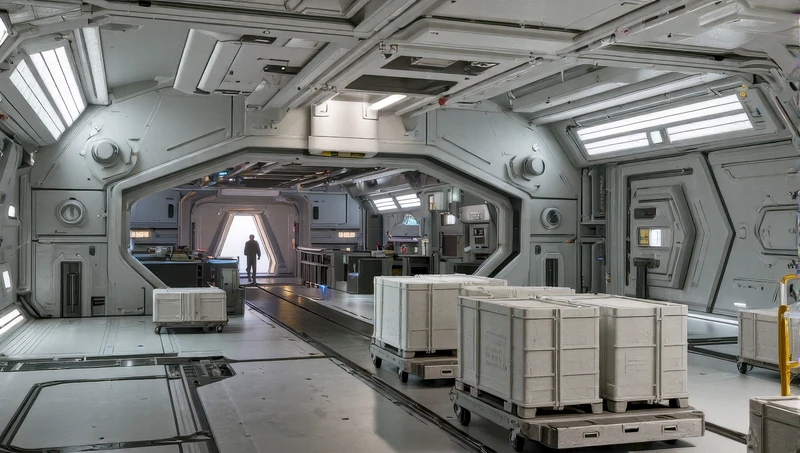
Méndez, A. (2025). Cargo Distribution Area – VII. Digital art, ArtStation.
https://www.artstation.com/artwork/DLJkJA
-
Leave a Reply